
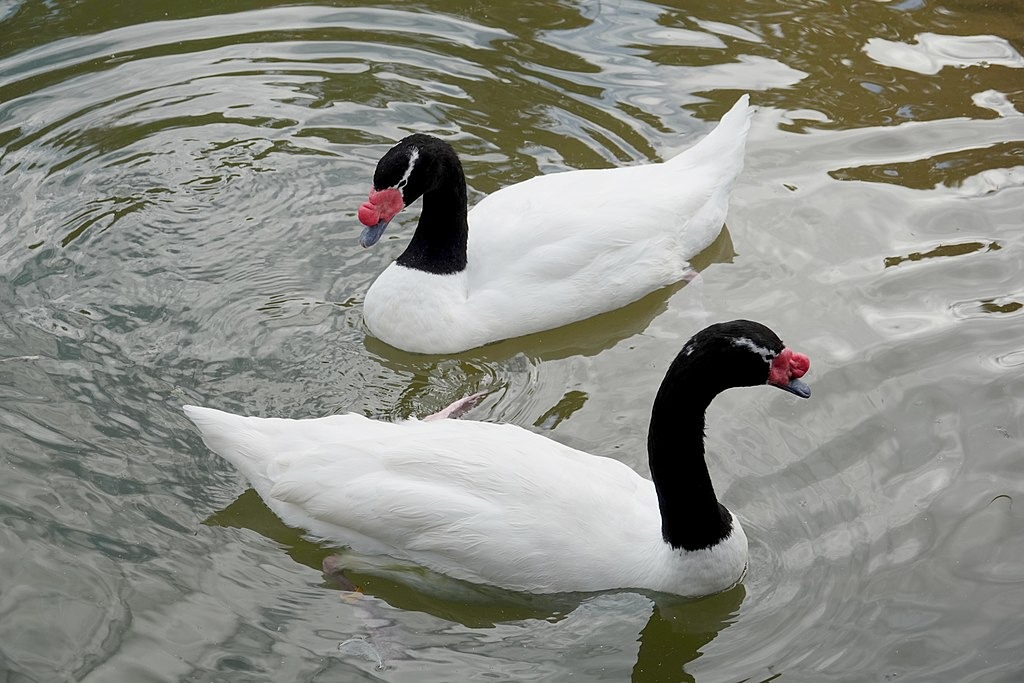

Description
Black Necked Swans
The Black-necked Swan is the largest waterfowl native to South America. They spend much of their time on the water as they are poor at walking due to their legs being set far back on their bodies. This makes it difficult for them to get airbourne but they are strong fliers. Like the Mute Swan, they are quiet birds.
Size
– Typical Adult is 115-140cm (45-55in).
Food
Mainly aquatic plants, insects, and fish spawn.
Habitat/Range
Wetlands, marshes, lagoons, and shallow lakes in southern South America – Chilean Southern Zone, Patagonia, Tierra del Fuego and on the Falkland Islands. In the austral winter, this species migrates northwards to northern Argentina, Paraguay and southern Brazil.
Breeding
July to August, and August to mid-September further south in the Falkland Islands.
Eggs
4 to 6 (creamy-white colour).
Habitat
These swans are found on a variety of wetlands, from shallow lakes, coastal lagoons to harbours and swampy river basins, often in close proximity to humans on the continent, but on the Falkland Islands are fairly shy (Woods & Woods 1997). They prefer areas of high water levels to feed and fair amounts of vegetation and pondweed.
Protection
CITES appendix II
IUCN Red List Assessment
Least Concern (LC)
Threats
Human hunting for sport and food. Used in Jewellery and handicrafts. Taken for pets and animal displays (BirdLife International 2012).




Swans Farm –
⭐⭐⭐⭐⭐
“Absolutely stunning birds. The pair arrived healthy and adapted very quickly to our private lake. Communication throughout the export process was excellent. Highly recommended.”
— Michael R., Texas, USA
Swans Farm –
⭐⭐⭐⭐⭐
“We imported two pairs to our estate in Dubai and they exceeded expectations. Beautiful genetics and very calm temperament. Professional export service from start to finish.”
— Ahmed Al Mansoori, Dubai, UAE
Swans Farm –
⭐⭐⭐⭐⭐
“Very impressed with the condition of the swans upon arrival in Johannesburg. Packaging and transport arrangements were handled professionally. Will definitely order again.”
— Pieter van Zyl, Gauteng, South Africa
Swans Farm –
⭐⭐⭐⭐⭐
“These black-neck swans are breathtaking in person. Healthy, active and exactly as described. Swan Farms made the international shipping process smooth and stress-free.”
— Elena M., Madrid, Spain
Swans Farm –
⭐⭐⭐⭐⭐
“Received our breeding pair safely in Ontario, Canada. Excellent quality birds with beautiful markings. Customer support was responsive during the entire export process.”
— Daniel Cooper, Toronto, Canada
Swans Farm –
⭐⭐⭐⭐⭐
“I was nervous ordering exotic waterfowl online, but Swan Farms proved to be trustworthy and professional. The swans settled perfectly into our pond.”
— Lucas Ferreira, São Paulo, Brazil
Swans Farm –
⭐⭐⭐⭐⭐
“Top quality birds and genuine exporters. Delivery to Nairobi was faster than expected and all health documents were properly arranged.”
— Joseph Mwangi, Nairobi, Kenya
Swans Farm –
⭐⭐⭐⭐⭐
“These are by far the most elegant swans we’ve added to our collection. Healthy feathers, strong birds, and excellent customer service.”
— Claire Dupont, Lyon, France